
Sorry, you need to enable JavaScript to visit this website.

Museum of Classical Archaeology Databases

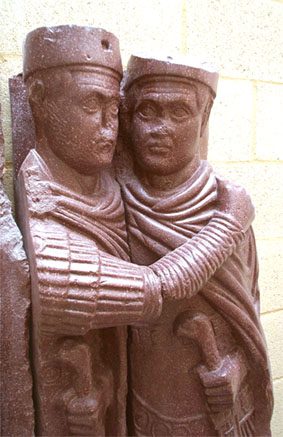
Diocletian, Maximian, Constantius Chlorus and Galerius.

After years of unrest, the four rulers were jointly in power of the Roman Empire from 282 CE; but rivalries led to the collapse of the Tetrarchy by 313. Their poses and similarity to each other is a display of political unity, just as the Empire was splitting into two halves, eastern and western.

Originally made for the Imperial Palace in Constantinople (Istanbul), the Tetrarchs were plundered by the Venetians in the thirteenth century and have remained ever since in St Mark’s Square.

This cast emulates porphyry, the expensive and unusual Egyptian stone used only for sculptures of emperors

Number
638
Material
Porphyry
Location of Original

In situ, St Mark's Basilica Venice

Size
1.61m
Accession

Robert Cook bequest. Purchased from Munich Institute for Classical Archaeology, 23 May 2003

References

Kleiner: Roman Sculpture, 399

Date
c.300
Provenance

Originally in Constantinople

Search Casts

Museum of Classical Archaeology, Cambridge

Every cast tells two stories.
One ancient. One modern.

Admission is free.


Opening hours

Tues-Fri: 10-5pm
Sat: 2-5pm (Univ. term-time only)
Sun & Mon: Closed

Closed on Bank Holiday Mondays

Visit us

Museum of Classical Archaeology
Faculty of Classics
Sidgwick Avenue
Cambridge
CB3 9DA

Get in touch

Tel. +44 (0)1223 330402
Email museum@classics.cam.ac.uk
Join our mailing list

​​

For an explanation of what personal information we gather when you visit the University’s website and details of how that information is used please see the following University Privacy policy:

https://www.cam.ac.uk/about-this-site/privacy-policy

Copyright statement

All images and material on our websites are ©Museum of Classical Archaeology, University of Cambridge unless otherwise stated. Please contact us to reproduce our images using a CC BY-NC-ND 4.0 licence.

See also our Copyright Notice and Take Down Policy.

Important Information

Museum of Classical Archaeology Web Accessibility Statement