
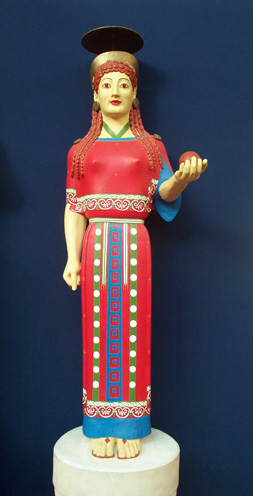
This is a reconstruction of the Peplos kore, a partner to our
unrestored version. Like all reconstructions, it is an act of imagination. This one was created in 1975 by our then-Curator, Prof Robert M. Cook.
The ancient Greeks painted their marble sculpture in bright pigments. Unfortunately these pigments are not very durable and – until the nineteenth century at least – the tendency was to remove residual traces, giving the lasting, fashionable and ultimately dangerous impression that this sculpture had always been white.
In the late nineteenth century, excavations on the Acropolis in Athens found several statues on which traces of colour could still be seen - and that colour was not removed and captured in watercolour paintings by the Swiss painter Émile Gilliéron. This statue — or ‘kore’ (meaning ‘maiden’ in ancient Greek) – is the best known of these statues.
Inspired by the residual paint traces and by these paintings, Cook reconstructed the statue as wearing a red outer garment or ‘peplos', trimmed with a white and green pattern on its edges and with a vertical band of squares running down the front of the skirt. Holes on the head and in the ears of the original had him give the cast a crown, earrings and a gold umbrella or ‘meniskos’ to protect it from the birds. He then restored its missing left hand to hold a ball.
More recent reconstructions have reconstructed her dress and what she is holding very differently, questioning whether she is a mortal girl in a peplos and preferring to see her as an image of the goddess Artemis.
Location of Original
Athens Acropolis Museum 679
Accession
Purchased in 1975 from Dresden
References
Lippold: Griechische Plastik, 77 (n.9), pl. 23.2
Karo: Personality in Greek Archaic Art, 264-
Schrader: Archaischen Marmorbildwerke des Akropolis (1939), 45-, pl. 1 (for colour)
Payne & Young: Archaic Marble Sculpture from the Acropolis, 18-
Cook: Journal of Hellenic Studies 96 (1976), 153-4 (for colour and meniskos)
Lehmann: Altgriechische Plastik, 52-57, pl. XVIII (for colour)
Efemeris Archaiologike: 1887, pl. 9 (for colour)
Ridgway: Journal of the Walters Art Gallery, XXXVI (1977)
Cook: Journal of the Walters Art Gallery, XXXVII (1978)
Stewart: Greek Sculpture, 123, pls. 147 &149
Panzanelli (ed.): The Color of Life (2008), 126
American Journal of Archaeology, vol 112 no 2 (April 2008), 347-351
Provenance
Discovered in 1886 on the Acropolis, Athens