
Sorry, you need to enable JavaScript to visit this website.

Museum of Classical Archaeology Databases

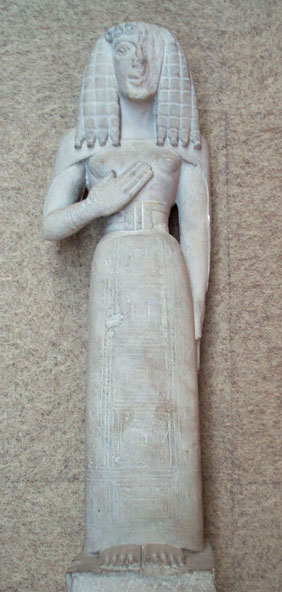
This is an early miniature limestone female figure. It came to light in Auxerre, France, but is thought to have come originally from Crete.

Rounded surfaces and gentle curves are skillfully combined with straight lines and flat planes. The sculpture was brightly coloured too, adding to the visual effect

Number
2
Material
Yellowish grey limestone
Location of Original

Paris Louvre 3098

Size
0.65m
Accession

Purchased from the Louvre in 1922

References

Lippold: Griechische Plastik, 22 (n.1); pl. 2.3
Karo: Personality in Greek Archaic Art, 93-4
Jenkins: Dedalica, 42
Collignon: Monuments et Memoires - Fondation Eugène Piot XX 1913, 5-38
Collignon: Revue Archéologique XI 1908, 153-170
Stewart: Greek Sculpture, 107, pls. 27-8
Richter: Korai (1968), 32, no.18, pls. 76-79
Richter: Ancient Italy, 8
Martinez: La Dame d'Auxerre
Karakasi: Archaic Korai (2003), 56

Date
c.640 BCE
Provenance

Uncertain

Search Casts

Museum of Classical Archaeology, Cambridge

Every cast tells two stories.
One ancient. One modern.

Admission is free.


Opening hours

Tues-Fri: 10-5pm
Sat: 2-5pm (Univ. term-time only)
Sun & Mon: Closed

Closed on Bank Holiday Mondays

Visit us

Museum of Classical Archaeology
Faculty of Classics
Sidgwick Avenue
Cambridge
CB3 9DA

Get in touch

Tel. +44 (0)1223 330402
Email museum@classics.cam.ac.uk
Join our mailing list

​​

For an explanation of what personal information we gather when you visit the University’s website and details of how that information is used please see the following University Privacy policy:

https://www.cam.ac.uk/about-this-site/privacy-policy

Copyright statement

All images and material on our websites are ©Museum of Classical Archaeology, University of Cambridge unless otherwise stated. Please contact us to reproduce our images using a CC BY-NC-ND 4.0 licence.

See also our Copyright Notice and Take Down Policy.

Important Information

Museum of Classical Archaeology Web Accessibility Statement