
Sorry, you need to enable JavaScript to visit this website.

Museum of Classical Archaeology Databases

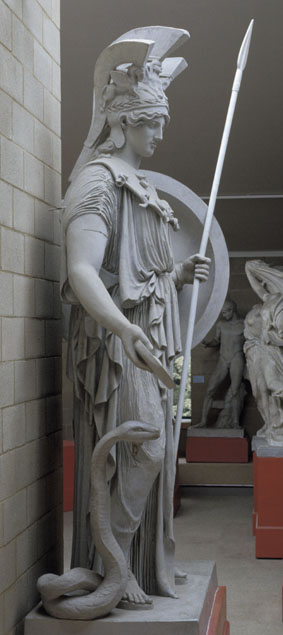
A composite restoration emulating the Athena Parthenos by the German scholar Walther Amelung. Created from the Lemnian Athena, the Vienna Head, and the Medici Torso in the Louvre. We know from written descriptions that the shield should be decorated with battle scenes, and that the right hand should hold a Nike figure representing victory, not the dish shown in this cast

Number
170
Location of Original

Munich Glyptothek

Size
2.46m
References

Thiersch: Die Athena Areia des Pheidias und der Torso Medici in Paris. Nachrichten von der Gesellschaft der Wissenschaften zu Göttingen, New series II, no.10, pl. XII. Torso Medici, pl. II
Amelung: Jahreshefte XI (1908), fig.71 (body) fig.62 (head)
Schrader: Jahreshefte XIV (1911), 38
Lawrence: Classical Sculpture (1928), 198-
Hurwit: The Athenian Acropolis (1999), 187 (for Athena Parthenos)

Date
Original: 440 BCE
Provenance

Exists only as a pastiche

Search Casts

Museum of Classical Archaeology, Cambridge

Every cast tells two stories.
One ancient. One modern.

Admission is free.


Opening hours

Tues-Fri: 10-5pm
Sat: 2-5pm (Univ. term-time only)
Sun & Mon: Closed

Closed on Bank Holiday Mondays

Visit us

Museum of Classical Archaeology
Faculty of Classics
Sidgwick Avenue
Cambridge
CB3 9DA

Get in touch

Tel. +44 (0)1223 330402
Email museum@classics.cam.ac.uk
Join our mailing list

​​

For an explanation of what personal information we gather when you visit the University’s website and details of how that information is used please see the following University Privacy policy:

https://www.cam.ac.uk/about-this-site/privacy-policy

Copyright statement

All images and material on our websites are ©Museum of Classical Archaeology, University of Cambridge unless otherwise stated. Please contact us to reproduce our images using a CC BY-NC-ND 4.0 licence.

See also our Copyright Notice and Take Down Policy.

Important Information

Museum of Classical Archaeology Web Accessibility Statement